Why disability leadership must move from presence and lived experience to lived expertise, executive capability and authority
Jeramy Hope | Thought leadership supporting the Beyond Representation doctoral research program
I am angry.
Not because disability is absent from organisational language. In many organisations, it is everywhere.
We speak about inclusion, lived experience, co-design, accessibility, diversity, representation and “nothing about us without us”. We write strategies. We craft policies. We acknowledge disability in speeches, values and governance documents.
All of that matters.
But saying the right words is not the same as redistributing power.
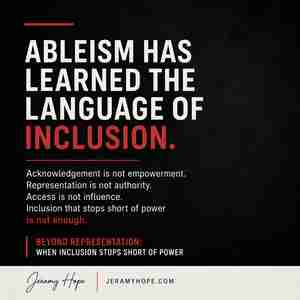
Ableism has learned the language of inclusion.
That is the part I think we need to be more willing to confront.
Language is not power.
An organisation can use disability-affirming language and still operate in ways that diminish disabled people.
It can invite lived experience into the room while reserving real authority for others. It can celebrate representation while discounting judgement. It can value the credibility, relationships and perspective a disabled leader brings while remaining uncomfortable when that leader exercises authority, challenges assumptions or expects to be treated as an executive first.
That is why I think we need to distinguish between symbolic inclusion and meaningful inclusion.
Symbolic inclusion asks: Is a disabled person present?
Meaningful inclusion asks: Does that person have authority? Are their judgement and professional expertise respected? Can they influence strategy? Do they have meaningful decision rights? Are they supported to lead, disagree, challenge and reshape the system?
The test is not whether disability appears in the policy.
The test is what happens when a disabled person exercises authority.
The convenient disabled leader
There is a form of ableism that celebrates the presence of disabled people while remaining uncomfortable with their authority.
It wants the story, but not necessarily the judgement.
It wants the perspective, but not always the authority.
It wants the relationships, networks, legitimacy and access a disabled leader may bring, but can fail to recognise the executive capability, professional expertise and years of work that created them.
I have been thinking a lot about this distinction.
If a non-disabled executive has strong relationships with ministers, departments, regulators, boards and sector leaders, we describe them as influential, politically astute, strategic and well-connected. Those relationships are treated as executive capital.
When a disabled executive has those same relationships, they can be treated differently: as “access”.
The disabled person becomes useful because they can open a door, legitimise a conversation, demonstrate representation or provide access to government and community.
That is very different from recognising them as the executive who built those relationships through judgement, credibility, trust, performance, policy knowledge, persistence and leadership.
The distinction is not semantic. It goes to dignity, professional identity and power.
A disabled leader should not become a convenient organisational asset: credible enough to open doors, visible enough to demonstrate inclusion, connected enough to confer legitimacy, but not empowered enough to shape strategy, challenge assumptions or exercise the authority of their role.
That is not elevation.
It is extraction.
From lived experience to lived expertise
This is where the work of Associate Professor Shane Clifton and colleagues has become important to my thinking.
Clifton et al. (2025) distinguish disability lived experience from disability lived expertise. Their framework does not suggest that simply having a disability automatically creates expertise. Rather, lived expertise develops through reflection, learning, knowledge, skills, values, community engagement and applying experience with purpose.
That distinction matters.
A related 2025 paper by Clifton and colleagues goes further, warning that lived experience can be reduced to subjective narrative or suffering and separated from professional or academic expertise. Their argument strengthens an important point for me: lived expertise is developed knowledge. It should be recognised as expertise that can inform, challenge and reshape systems, not simply as testimony invited into them.
It moves us away from treating disabled people simply as sources of personal stories and towards recognising that experience can become developed knowledge.
In a 2026 discussion about lived expertise, Clifton put it simply:
“We shouldn’t apologise for what disability has taught us.”
I keep returning to that sentence.
I would add this: organisations should not require disabled people to keep proving the value of what disability has taught them.
Nor should they value that expertise only when it is useful to an existing agenda.
Lived expertise should be able to inform, contradict, challenge and change organisational thinking. If it can only be expressed when it confirms what those already in power want to hear, it is not being treated as expertise.
It is being used as an endorsement.
The research question underneath the anger
This tension sits directly beneath the research I am developing: Beyond Representation: The Strategic Value of Disability in Executive Leadership, Governance and Organisational Performance.
This research builds on established disability leadership critiques of tokenism and representation, and on Clifton and colleagues’ distinction between lived experience and lived expertise. The question I want to take further is what happens when that lived expertise sits alongside executive capability and genuine authority, and whether that combination changes leadership, governance and organisational outcomes.
This research does not start from the claim that disability automatically creates better leaders.
Disability is diverse. Our lives, impairments, identities, opportunities, exclusions and organisational contexts are different. Some experiences create knowledge. Some create barriers. Some create trauma. No serious research should romanticise exclusion or turn structural disadvantage into another expectation that disabled people must be “resilient”.
The proposition I want to investigate is more precise.
What happens when disability lived experience is reflected on, learned from and developed into lived expertise?
What happens when that expertise sits alongside professional education, executive experience, governance knowledge and genuine authority?
What organisational conditions allow this combined capability to influence strategy, governance, risk, stakeholder relationships, innovation, organisational performance and public value?
The conceptual pathway I am increasingly interested in looks like this:
Representation
→ disability lived experience
→ reflection and learning
→ disability lived expertise
→ executive capability
→ authority and decision rights
→ leadership and governance practice
→ organisational performance and public value
Representation is therefore not the destination.
It is, at best, an entry point.
The critical movement is from being seen, to being heard, to being respected as knowledgeable, to being entrusted with authority, and ultimately to shaping organisational decisions and outcomes.
Authority is the test
This is one of the uncomfortable gaps in contemporary inclusion practice.
We have spent significant effort improving representation. We have developed advisory groups, lived-experience panels, co-design processes, employee networks, disability action plans and consultation structures.
These mechanisms can be valuable.
But they can also leave the underlying structures of power untouched.
A person can be consulted without being influential.
A person can be visible without being powerful.
A person can be invited to speak without being given decision rights.
A disabled executive can hold a senior title while still facing subtle expectations that they remain grateful, agreeable, inspirational, representative or useful rather than authoritative.
That is why authority matters so much.
Authority means being trusted with consequential decisions.
It means professional judgement is taken seriously, even when it is inconvenient.
It means being able to say no.
It means being able to challenge a board, an executive team, a policy position or an established way of working without disability becoming part of the explanation for why that challenge feels uncomfortable.
It means receiving the same recognition for strategic relationships, intellectual contribution, organisational performance and leadership impact as any other executive.
It also means being allowed to fail, disagree, change direction and exercise imperfect judgement without any of it being treated as evidence about the capability of disabled people generally.
Equality includes the right to be ordinary as well as exceptional.
When inclusion becomes conditional
There is another risk.
Sometimes organisations are comfortable with disability leadership only when it remains aligned with the institution’s existing preferences.
The disabled person is welcomed when they bring insight, connection, legitimacy or credibility. Their lived experience is praised when it is emotionally compelling. Their networks are valued when they advance organisational objectives.
But what happens when lived expertise leads to a different conclusion?
What happens when the disabled leader says the policy is wrong?
What happens when they question governance, challenge a commercial assumption, resist a convenient narrative, demand a higher standard, or say that a decision described as “inclusive” is not inclusive at all?
That moment tells us far more about organisational inclusion than any strategy document.
If the system only wants the part of disabled leadership that validates the system, it does not want lived expertise.
It wants compliance with a lived-experience label attached.
Real inclusion has to make room for disabled leaders to be inconvenient.
What real elevation looks like
If organisations are serious about disability leadership, the ambition must move beyond access and representation.
We should create more pathways into executive leadership, boardrooms, statutory appointments, senior public service, policy leadership, academia, investment, governance and institutional decision-making.
We should identify and develop disability lived expertise as a potential source of leadership capability, without stereotyping disabled people or assuming a universal experience.
We should examine whether organisational cultures allow disabled leaders to use the capabilities they bring, or suppress those capabilities through inaccessible systems, low expectations, paternalism, tokenism or restricted decision rights.
And we should ask harder questions.
Who gets to define expertise?
Whose judgement is presumed credible?
Who is allowed to exercise power without having to continually justify their presence?
Who receives credit for relationships, influence and outcomes?
Who is invited to contribute, and who is trusted to decide?
These are not simply disability questions.
These are questions about governance, organisational culture, leadership, institutional power and performance.
Beyond representation
I am writing this from a place of anger, but not only anger.
I am also writing it from conviction.
I believe disability leadership has something much more significant to offer than representation alone. The conversation needs to mature beyond employment participation, visibility and consultation, and begin to examine executive capability, governance authority and organisational contribution.
I also believe we need to be careful.
The answer is not to turn disability into a leadership superpower. It is not to glorify adversity. It is not to suggest that disabled people owe organisations exceptional resilience, insight or performance in return for being included.
The stronger proposition is that disability can be a source of knowledge and developed expertise, just as other significant experiences can shape how leaders understand systems, risk, relationships, uncertainty, ethics and change.
When that expertise combines with executive experience and genuine authority, it may create capabilities organisations have barely begun to understand.
But those capabilities cannot contribute if an organisation values a disabled person’s symbolism more than their judgement.
They cannot flourish if relationships are extracted but expertise is discounted.
They cannot shape outcomes if the person is present but power remains elsewhere.
So perhaps the next phase of disability inclusion requires a different question.
Not: Do we have disabled people in the room?
But:
Are disabled people being developed, trusted, elevated and empowered to shape what happens in the room?
Because acknowledgement is not empowerment.
Representation is not authority.
Access is not influence.
And inclusion that stops short of power is not enough.
References
Clifton, S., Cooper, E., Bourke, J., Connor, S., Denton, S., Dominish, B., Drinkwater, A., Gibellini, C., Gilroy, J., Hallahan, L., Jessep, S., Katterl, S., Mellifont, D., O’Brien, B., Farrant, F. Q., Watharow, A., & Wynn, R. (2025). A framework for disability lived expertise. Evidence & Policy, 1–21. https://doi.org/10.1332/17442648Y2025D000000069
Clifton, S., Cooper, E., Bourke, J., Connor, S., Denton, S., Dominish, B., Gibellini, C., Gilroy, J., Hallahan, L., Jessep, S., Katterl, S., Mellifont, D., O’Brien, B., Farrant, F. Q., Watharow, A., & Wynn, R. (2025). Disability lived experience and expertise: recognising the expert contributions of people with disability. Evidence & Policy, 21(4), 578–595. https://doi.org/10.1332/17442648Y2025D000000060
Community Industry Group. (2026, May 13). Lived expertise: With Dr Shane Clifton – Nothing about us without us! [Podcast episode]. Community Matters.
 Jeramy Hope