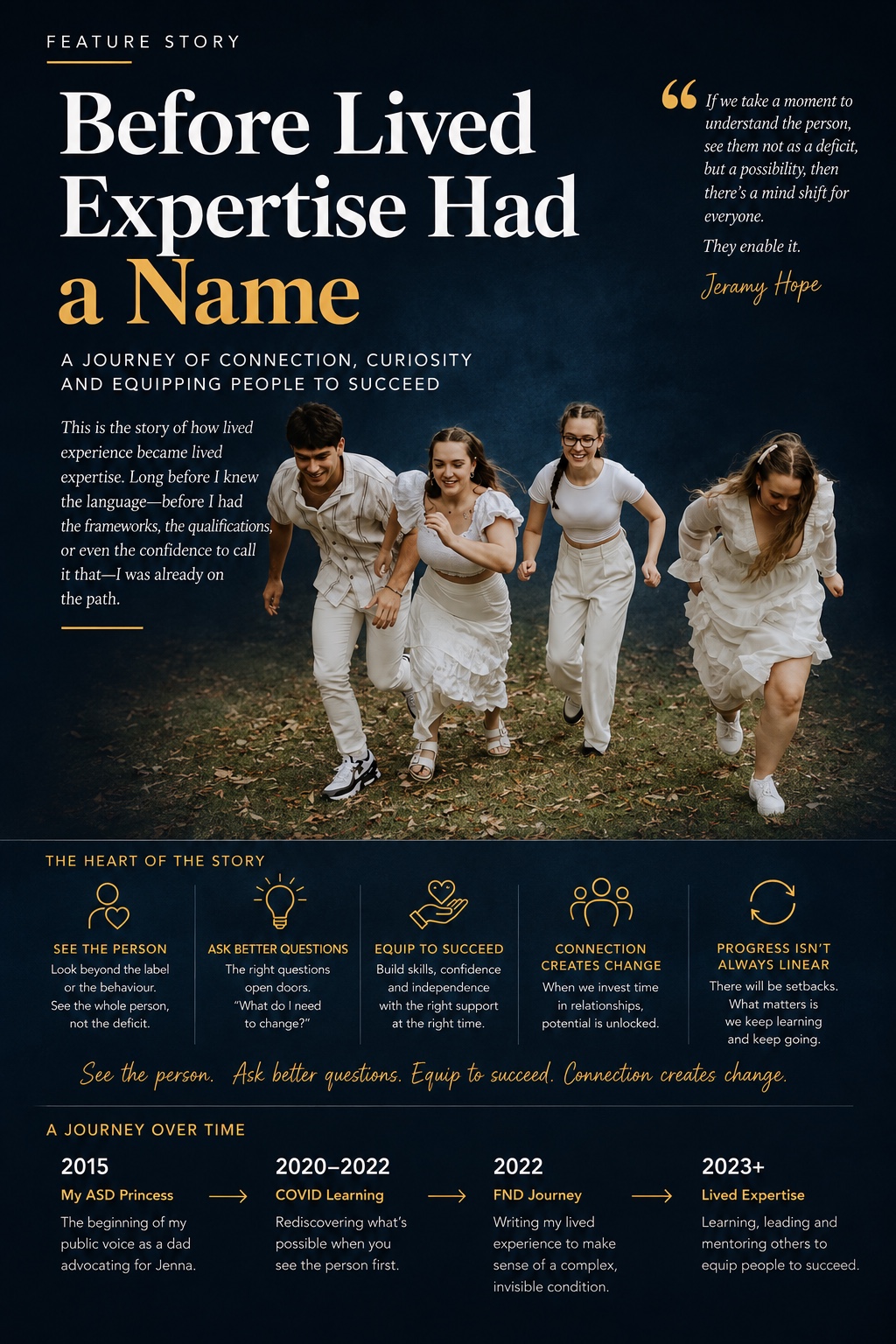
Parenting, disability, leadership and the long road from experience to expertise
Jeramy Hope | Personal reflection supporting the Beyond Representation doctoral research program
When the expected path disappeared
My adult life did not begin with a clear plan.
In my early twenties, I was working in a nursing home and helping a resident shower when they suddenly passed away. I did not realise they had died until their body began to collapse. Instinctively, I tried to catch them as they fell. I was left with a significant workplace injury that became a WorkCover claim and took me out of work for months.
We were young, overwhelmed and, for a while, fairly lost.
The injury had taken away the work and independence I had expected to keep building on, and we had no financial buffer. We were trying to pay the bills and work out what came next.
Money was tight.
At times, we were simply trying to survive.
I picked up horse manure for $20.
We lived, at times, on church donations of Weet-Bix and noodles.
There was no grand plan for reinvention. I needed to retrain because I needed to find a way to keep working, support my family and build something sustainable from where we were.
At the same time, I was rehabilitating, Kathryn was working multiple jobs, we were approaching our first wedding anniversary, and then we found out we were going to be parents.
Life had not stopped while I recovered.
So neither could we.
Learning to lead before I knew what leadership was
My first formal leadership role came when I was 23, working in supported housing.
But leadership had started earlier.
As a teenager in The Salvation Army, I helped run youth groups, bands and events. I organised activities and volunteers, played and directed music, and gave leadership and youth talks.
Sometimes leadership arrived with very little warning.
There were occasions when, because of what was happening in our family, I would find out 10 or 15 minutes beforehand that I needed to give the sermon.
I learnt to stand up, gather my thoughts and work with what I had.
At the time, I probably did not think of any of this as leadership development.
It was simply what needed to be done.
But I loved bringing people together, creating something and watching people grow.
Working in group homes taught me something different.
It taught me about people.
Looking back, those early years became an apprenticeship of sorts.
I was learning management, but I was also learning something much more important about leadership.
My instinct was to get my hands dirty.
To be in the room.
To watch.
To listen.
To ask questions.
To try something.
To see what happened.
To adapt, tweak, train and sometimes rewrite the approach on the fly.
Looking back, I can see elements of servant leadership and walking alongside people in the way I was trying to lead, although I did not have sophisticated language for it at the time.
The principle felt simple.
My job was not to make people dependent on me.
It was to equip people to succeed.
That applied to staff and to the people with disability we supported.
With staff, it meant building confidence, sharing knowledge and giving people enough authority to make good decisions rather than waiting for the manager to solve everything.
With the people we supported, it meant looking for what someone could do, understanding what was getting in the way, providing the right amount of support and creating opportunities for them to exercise choice and agency.
The two were connected.
If staff felt trusted, supported and equipped to think, they were better able to create those same conditions for the people they supported.
And because I was close to the practice, I could see what was actually happening.
A strategy could look sensible on paper and fail completely in the room.
Something we assumed a person could not do might become possible when we changed the way support was provided.
A staff member could try something, learn from the response and adjust again.
The learning became practice.
Then the practice became better.
The people with disability I worked alongside became some of my most important teachers.
I saw grit.
Courage.
Humour.
Creativity.
Entrepreneurial spirit.
People finding ways around systems, barriers and expectations that had not been designed with them in mind.
I also began noticing where barriers actually sat.
Sometimes they were connected to a person’s impairment.
But often they were around the person.
In attitudes.
In culture.
In social expectations.
In services.
In rules.
And in the low expectations of other people.
Years later, the work of Christine Bigby, Jade McEwen and others would give me language for some of what I had learnt through practice.
Person-Centred Active Support asks us to enable meaningful participation by providing the right assistance and adapting support to the person, rather than simply doing things for them.
Research into service quality and practice leadership also reinforces something I recognise immediately from those early years: quality has to become visible in what people actually do.
Did somebody notice?
Did they ask another question?
Did they change the approach?
Did they help without taking over?
Did they create an opportunity for choice?
Did a manager observe, coach and help staff improve?
Did we learn from something that had not worked?
That was why being present mattered so much to my leadership.
I could learn.
I could coach.
I could see the gap between policy and practice.
And I could change something while it still mattered.
I learnt that support did not mean doing everything for someone.
Protection could become restriction.
Care could become control.
Good intentions did not necessarily produce good outcomes.
That tension feels particularly important looking back from today.
We have stronger regulation, standards, safeguards and accountability for good reason.
People with disability have the right to be safe.
But safety and agency are not opposites.
It leaves me wondering whether, in some settings, stronger compliance and organisational risk management have unintentionally crowded out discretion, relational practice, dignity of risk and the freedom to learn, adapt and sometimes get things wrong.
That is a question rather than a conclusion.
But it is one worth asking.
Sometimes we look at a person and see a limitation, when what we are actually seeing is the barrier we have placed around them.
Building a family while we were still growing up
By our late twenties, Kathryn and I were raising four children.
Life was full, and we were learning as we went.
We were still growing into ourselves while trying to guide four little people as they grew into themselves too.
We certainly did not have a parenting philosophy written down.
But there were things that mattered to us.
We wanted books in the house.
We read to the kids every night.
We wanted them to be curious, to ask questions, explore, play and imagine.
We wanted them to know that learning did not only happen at school.
It happened around the dinner table.
In the car.
Through music.
On adventures.
Through mistakes.
And through those endless questions children ask that you realise, as a parent, you do not actually know the answer to.
We wanted our kids to think independently, dream big, be a little silly and be comfortable being themselves.
That did not always make for a quiet household.
We had four fiercely independent children, each with their own personality, interests and ideas about how the world should work.
While Kathryn studied for her first degree, I would often take the four kids out on adventures so she could study.
We explored.
We played.
We laughed.
Sometimes there was a plan.
Sometimes we simply went somewhere and worked it out as we went.
Those days became another kind of classroom for me.
I was learning about my children by watching them.
What excited them.
What frightened them.
What made them curious.
What caused them to withdraw.
What happened when I pushed too hard.
And what happened when I gave them enough space to find their own way.
Kathryn’s study brought another kind of learning into our home. We would talk about what she was studying, wrestle with ideas and test some of those academic questions against what we were actually experiencing as parents.
My education was happening differently.
I was learning through work.
Through leadership.
Through music.
Through parenting.
Through the people with disability I worked alongside.
And, increasingly, through one little girl who seemed to experience parts of the world differently from her brothers and sisters.
Then disability came home
By the time disability became part of our family story, I thought I knew something about disability.
I had worked in supported housing. I had led teams. I had seen systems work well and fail badly. Most importantly, I had learnt from people with disability themselves.
Then I became the dad of a little girl who experienced the world differently.
Suddenly, what I knew professionally did not feel like enough.
There were appointments, assessments and explanations.
ADHD.
Hearing.
Behaviour.
Later came anxiety, depression, sensory processing and, eventually, autism.
There were also labels that had nothing to do with diagnosis.
Naughty.
Loud.
Difficult.
Weird.
A misfit.
At different points, we heard versions of all of them.
Our journey became one of discovery.
Finding supports.
Building understanding.
Helping Jenna develop capacity and, as she grew older, supporting her to find her own agency.
But much of the world around her seemed focused on something different.
Fixing the problem.
Stopping the behaviour.
Helping her become more like everyone else.
Like many parents, I initially searched for answers.
What had we missed?
What were we doing wrong?
What treatment did she need?
How could we help her fit?
Some of those questions came from love.
Some came from fear.
And some came from assumptions about disability that I had absorbed despite years of working in the sector.
In January 2015, I started writing about it on a blog I called My ASD Princess.
In one of the first posts, My Princess, I wrote about those labels and the questions I was asking myself.
I was trying to work out what I had done wrong.
What I had missed.
What we needed to fix.
But another question appeared in that old writing too.
What do I need to change?
I did not know it then, but that question would follow me for years.
Underneath the assessments, behaviours, diagnoses and strategies, Jenna was still our daughter.
Funny.
Determined.
Curious.
Frustrating.
Loving.
Unpredictable.
Completely herself.
She was Jenna.
And slowly, we began to understand that helping her did not always mean changing her.
Sometimes we needed to change what was around her.
We experimented.
With routines.
Predictability.
Sensory supports.
Different ways of learning.
Preparing for unfamiliar places.
Recovery afterwards.
Knowing when to push and when to stop pushing.
Sometimes it worked.
Sometimes we got it completely wrong.
And sometimes something worked beautifully for months, only for one part of the environment to change and everything to fall apart again.
Later that same year, in Thank You for Being Brave, I thanked Jenna for “teaching me to see the world differently.”
That is what was happening.
She was teaching me.
The same child could appear capable in one environment and completely overwhelmed in another.
The person had not suddenly changed.
The conditions had.
You cannot understand someone’s capability without also looking at the environment in which you are asking them to demonstrate it.
When school could not bend
From around Year 3, Jenna rarely managed a full week of school.
Over the years there were different schools, different teachers, different plans and different attempts to make education work.
There were Individual Education Plans. Meetings. Strategies. Adjustments written down on paper.
But too often, the plans seemed better at documenting what was happening than building the structures Jenna actually needed to succeed.
For a child who thrived on routine and needed predictability, school could be extraordinarily unpredictable.
A teacher was away.
A relief teacher arrived.
There was an excursion.
The timetable changed.
There was an altercation in the playground.
A classroom moved.
Something happened that might have seemed relatively minor to everyone else.
For Jenna, it could mean we started again.
Sometimes the impact lasted hours.
Sometimes days.
Sometimes much longer.
We organised our lives around that uncertainty.
There were cruel children.
There were also many well-intentioned teachers trying to help within classrooms and systems that were under-resourced and not designed for someone who needed the level of consistency Jenna required.
That distinction matters to me.
This is not simply a story about bad teachers.
It is about systems struggling to accommodate a child whose needs did not fit comfortably within the way education was organised.
And when the system could not bend, Jenna was expected to.
Some of the things that helped her most were also misunderstood.
Sensory tools could be seen as toys.
Stimming could be seen as behaviour to stop rather than something helping her regulate.
Withdrawal could be interpreted as refusal.
Distress could become a behaviour problem.
At home, we were trying to understand what helped her regulate, what reduced distress and what kept her safe.
At times, self-harm was a very real concern.
Something as simple as having the right object in her hands, knowing exactly what was happening next, having somewhere safe to withdraw, or being given time to regulate could change the course of an entire day.
But accommodation requires more than allowing someone into the room.
It requires understanding what they need in order to remain there.
The old blog recorded these changes as they happened.
In Take 3, I wrote about what happened when support was reduced and progress that had taken months to build began to disappear.
In High School: Unpredictable, Harsh, Damn Hard Work, I was writing about something even bigger.
Our fear was no longer simply whether Jenna would attend school tomorrow.
We were thinking about independence.
Work.
Relationships.
Friendship.
A life beyond us.
The things every parent wants to believe are possible for their child.
There is a particular frustration in watching someone demonstrate that they can learn, participate and grow under the right conditions, then watching that ability disappear when those conditions are removed.
We saw that repeatedly.
Progress.
Disruption.
Distress.
Withdrawal.
Recovery.
Start again.
It became a cycle.
Eventually, I began to wonder whether we were measuring the wrong person.
The question was always whether Jenna could cope with school.
Less often did we ask whether school could cope with Jenna.
Whether the environment could adapt.
Whether the supports were actually supports.
Whether the plan changed anything in practice.
Whether success should be measured only by attendance and compliance, or by learning, development, safety, agency and the possibility of a life beyond school.
There were days when Jenna came to work with me because school could not hold her.
In one sense, that looked like education failing.
But she was still learning.
She was watching people work.
Listening to conversations.
Meeting people.
Seeing how organisations operated.
Experiencing a world beyond the classroom.
It was not the education pathway we had imagined for her.
Much of our journey with Jenna became like that.
When the expected pathway stopped working, we had to stop asking how to force her back onto it and start asking what another pathway might look like.
That did not mean lowering our expectations.
In many ways, it meant the opposite.
It meant refusing to confuse her difficulty surviving a particular environment with the limits of what she might become.
When the world stopped
Then COVID stopped the world.
Like families everywhere, we suddenly had children learning from home.
The challenges did not disappear.
Learning differences did not disappear.
Anxiety did not disappear.
There were still educational gaps and areas where each of our children struggled.
But many of the interruptions disappeared.
There was no classroom disruption.
No being sent to the principal’s office.
No playground politics.
No constant comparison with the person sitting beside you.
Less pressure to move on simply because the timetable said it was time.
The problems had not disappeared.
We had changed what we were focusing on.
Kathryn is an amazing teacher, but during that period she also had something classroom teachers rarely have.
Time.
Time to understand each child as an individual.
Time to work out where their learning actually sat.
Time to understand the gaps.
And time to notice strengths.
Interests.
Patterns.
Motivation.
What made someone switch off.
What made them lean forward.
Instead of beginning with where the curriculum said they should be, she could begin with the person in front of her.
What do they understand?
Where are they getting stuck?
What are they good at?
What interests them?
What might make them want to try again?
What support would help them take the next step?
Then she could adjust.
Encourage.
Push gently.
Praise effort.
Use rewards when they helped.
Change the explanation.
Try another way.
Stay with something longer.
Come back to it later.
And gradually we started seeing things that were difficult to reconcile with some of the assumptions that had accumulated around our children.
From the work we were seeing at home, Jenna moved in areas of reading and writing from around a mid-primary-school level to work around a Year 11 level in less than a calendar year.
Isaac had struggled badly with mathematics and had come to hate the subject.
But when somebody had the time to slow down, help him understand the patterns and rules underneath it, and work with the way he thought, something shifted.
He became highly capable.
His results changed.
More importantly, his relationship with mathematics changed.
Neither child had suddenly become a different person.
Their underlying potential had not appeared because COVID arrived.
What changed was the opportunity to see them differently.
To pause.
To understand.
To find the tools.
To find the motivator.
And invest the time.
I am conscious that classroom teachers cannot reproduce that level of individual attention for every child in a class of 20 or 30 students.
That is not a criticism of teachers.
If anything, it raises questions about the structures we place around teachers too.
But the experience stayed with me.
When we started with the person rather than the deficit, different possibilities became visible.
That lesson matters enormously in disability support.
We talk a great deal about capacity building.
But capacity building has to mean more than helping somebody complete today’s tasks.
It requires curiosity about what might be possible tomorrow.
What does this person want?
What motivates them?
What can they already do?
What might they be able to do with the right support?
What skill could be built over time?
When should we assist?
When should we step back?
What does Person-Centred Active Support look like when it is genuinely future-focused?
There is enormous potential in the relationship between a person with disability and a good support worker.
But we do not always equip support workers with the skills, confidence, questions or permission to explore that potential.
Sometimes support becomes transactional.
Complete the shift.
Complete the task.
Keep the person safe.
Write the notes.
Move on.
Those things matter.
But there is another possibility.
To notice.
To ask.
To teach.
To encourage.
To practise.
To build confidence.
To help somebody discover something they did not know they could do.
And to keep looking beyond today’s support need towards tomorrow’s capability.
By 2018, years before COVID, I had written something in Only been given half the diagnosis, and half the answers that now feels remarkably familiar.
I wrote that our role as parents was to enable Jenna to dream, help her recognise a purpose for herself and equip her with the tools she needed to succeed.
I would use different language in places if I wrote those old posts today.
My understanding of autism, disability, agency and lived experience has continued to develop.
That matters.
I do not want to rewrite the younger version of myself so that he conveniently understood everything I understand now.
He didn’t.
Neither did we.
We were learning.
Sometimes slowly.
Sometimes painfully.
Sometimes by getting things wrong.
That is part of why I value those old posts.
They preserve the uncertainty.
They show my thinking changing.
And they record the questions before I had the language to explain why those questions mattered.
When disability became mine
While I was learning all of this through work and through our children, something else had been happening quietly in the background.
My own body had been changing.
Pain had been part of my life since the workplace injury in my early twenties.
For years, I learnt to manage it.
Work around it.
Push through it.
Keep going.
And for the most part, that worked.
I worked.
We raised our family.
I studied.
I led teams and organisations.
I played music.
I stayed involved in our community.
I built a career.
Life became busy, complicated and full.
And I became very good at maintaining the appearance that everything was fine.
Then, around 2015 and 2016, other things started happening.
Movements I could not control.
Tremors.
Changes in the way I walked.
Pain that became harder to work around.
My body started behaving in ways I could not simply explain away.
So I did what I had always done.
I adapted.
I compensated.
I found another way.
And I kept working.
There is an irony in that now.
I had spent years working alongside people with disability.
I had spent years fighting for Jenna to be understood as a whole person rather than a collection of deficits.
I believed that support could enable independence.
I understood that environments could create barriers.
I knew that doing something differently did not necessarily mean doing it less well.
I believed all of those things.
For other people.
Applying them to myself was much harder.
In September 2022, sitting in hospital during another significant rehabilitation admission, I started writing my own disability story.
In The Story So Far, I went back to the original workplace injury, the Weet-Bix and noodles, the years of pain, the seemingly endless diagnoses, specialists and treatments, and the years I had spent trying to understand why my body behaved the way it did.
Reading it now, one word stands out.
Mask.
My strategy had been to manage the pain well enough that I could continue working and mask whatever was happening.
That strategy had served me until it didn’t.
As the symptoms became more visible, there was embarrassment.
When your body moves in ways other people do not expect, people notice.
Sometimes they stare.
Sometimes they ask questions.
Sometimes they make assumptions.
Sometimes they laugh.
I became increasingly conscious of how I appeared.
Could people see the movements?
Could I sit somewhere they were less obvious?
Could I get through the meeting?
Could I walk into the room normally enough?
Could I keep working without people wondering whether I was still capable?
Underneath many of those questions was another one.
Could I hide it?
That question says something about disability.
It also says something about leadership.
I had built a career around being capable.
I was the person who solved problems.
Led teams.
Made decisions.
Supported other people.
Stepped into difficult situations.
Got things done.
Capability had become part of my identity.
Somewhere along the way, physical independence had become tangled up with my understanding of professional capability.
If I needed help, what did that say about me?
If I could not walk into a room the same way, would people still see the same leader?
If I needed to work differently, would that be interpreted as reduced commitment?
Eventually, Functional Neurological Disorder became part of the explanation for what was happening to me.
Having a diagnosis gave something a name.
It did not give me a map.
There were specialists. Appointments. Rehabilitation. Medication. Exercise. Pain management. Good periods. Bad periods. Progress. Setbacks.
My body increasingly required negotiation.
How far would I need to walk?
Where could I sit?
Was the venue accessible?
How long would I be there?
What would it cost me afterwards?
Could I recover before the next commitment?
Could I travel?
What support would I need?
Could I still do the work?
These were practical questions.
Underneath them was an identity question.
Who was I if I could no longer do everything the way I had always done it?
Learning to accept support
For much of my career, I had been the person providing support.
Receiving it was another matter.
In My FND NDIS Journey Begins, I wrote about how confronting it was to formalise disability.
To gather evidence.
To document weakness.
To stop hiding.
To turn the spotlight onto myself after years of advocating for other people.
I described myself as fiercely independent.
That was true.
I also recognised that I was often my own biggest roadblock when it came to accepting help.
The Australian male version of “she’ll be right” had served me for a long time.
Until it didn’t.
Gradually, the equipment appeared.
A stick.
A walker.
A wheelchair.
Support from other people.
Adjustments to how I worked.
More planning around things I once simply did.
Recovery time afterwards.
I resisted some of it.
Using equipment made my disability visible.
Accepting help could feel like admitting there was something I could no longer do.
Working differently meant acknowledging that I could not simply push through everything anymore.
Then something else started happening.
The right support gave things back.
Energy.
Participation.
Work.
Family time.
Travel.
Leadership.
Choice.
Instead of spending so much energy trying to appear unaffected, I could use more of it on the things that actually mattered.
There was something uncomfortable about realising how familiar this lesson was.
A sensory tool had not made Jenna less capable.
Routine had not made her less independent.
An adjustment had not lowered our expectations of her.
Those things had helped her participate, regulate, learn and have greater control over her own life.
I had fought for people to understand that.
Now I had to believe it about myself.
A wheelchair did not remove my leadership capability.
Working differently did not make my contribution less valuable.
Needing help did not mean I had stopped being independent.
Sometimes support was what made independence possible.
But I do not want to make that journey sound cleaner than it was.
There was grief.
There was anger.
There were things I lost.
There were things I could no longer do in the same way.
In My Disability is permanent. My current state is the new normal., I was confronting the possibility that rehabilitation was no longer about getting back to where I had been.
There were parts of my identity built around physical capability, endurance and simply pushing through.
And some experiences did not teach me anything useful at the time.
They simply hurt.
The learning came later.
Through questioning.
Reflecting.
Adapting.
Getting things wrong.
Trying something different.
Trying again.
By the time I wrote Nine Months of Self Discovery in 2024, I could look back across nearly two decades and see how long I had spent pretending I was okay until I couldn’t anymore.
Once again, I recognised the pattern.
I had watched people do it in group homes when I was 23.
I had watched our children do it.
I had watched Jenna do it again and again.
Now I was living my own version of it.
The question gradually became less:
How do I get back to being the person I was?
And more:
What do I need around me to become the person I can still be?
Taking it into leadership
I was still leading.
Leadership was not new to me.
By then, I had spent decades moving through increasingly complex roles, teams, organisations and systems.
I had learnt about budgets. Performance. Governance. Strategy. Culture. Risk. Accountability.
But the deeper lessons were travelling with me too.
The people I supported early in my career had taught me to question assumptions about capability.
Jenna had taught me to look at the environment before judging the person.
Our COVID experience had shown me how quickly assumptions about capability could change when the method, motivation and environment changed.
My own disability had forced me to understand the difference between being capable and having the conditions that allow you to demonstrate that capability.
I became increasingly interested in what happens around people.
What information do they have?
What authority do they hold?
What gets in their way?
What support do they need?
What assumptions are we making about them?
What happens when they challenge us?
Who gets listened to?
Who gets described as difficult?
Who gets another opportunity after getting something wrong?
And who gets quietly excluded from the places where decisions are actually made?
These are leadership questions.
They are also systems questions.
As my work moved further into executive leadership, governance, public policy and systems reform, I began seeing versions of the same patterns I had encountered much earlier.
Organisations could talk about inclusion while remaining remarkably rigid.
They could invite people with lived experience into a room without giving them meaningful authority.
They could celebrate diversity while expecting everyone to behave, communicate and lead according to the same narrow norms.
They could recruit someone because of the perspective they brought, then become uncomfortable when that perspective challenged the organisation.
I also saw something else.
People who had spent significant parts of their lives navigating complexity could sometimes bring valuable capabilities into leadership.
Not because hardship automatically creates good leaders.
It does not.
But because some people had spent years practising things organisations say they value.
Adapting when the expected pathway disappears.
Reading systems that were not designed for them.
Finding another way through.
Advocating.
Negotiating.
Managing uncertainty.
Recognising patterns.
Working with limited resources.
Understanding the consequences of decisions made far away from the people who have to live with them.
I recognised some of this in myself.
I recognised it in other disabled leaders, advocates and people with lived experience I worked alongside.
But I became increasingly uncomfortable with the way organisations talked about it.
We often stopped at lived experience.
We wanted the story.
The perspective.
The consultation.
The advisory group.
The person on the panel.
The seat at the table.
Those things matter.
But perhaps the question was not simply:
How do we include lived experience?
Perhaps it was:
What knowledge and capability has been developed through that experience, and are we prepared to give it any real authority?
When the environment gets it wrong
I know what it feels like when this does not work.
I have had employment experiences that failed, at least in part, because disability, access and leadership collided.
These were not situations where I suddenly stopped having executive capability.
I could still think strategically.
Lead.
Make difficult decisions.
Understand complex systems.
Build relationships.
Contribute.
But capability was not enough.
The environment around me mattered.
Senior executives and boards did not always have the skills, and perhaps more importantly the tools, to understand what enabling a disabled executive actually required.
Some of what might have helped was remarkably simple.
A clear conversation about access.
A practical process for requesting and reviewing adjustments.
Agreed ways of communicating when circumstances or capacity changed.
Clarity about what outcomes were essential and what could be done differently.
A trusted mentor.
A way to raise a problem before it became a crisis.
Sometimes there was no clear pathway.
And when there is no pathway, disability can become the problem.
For the individual, that can be devastating.
You can move from being recruited because of your experience, capability and potential to questioning whether you are capable at all.
There is a cost for the organisation too.
Failed executive appointments are expensive and disruptive.
Teams lose continuity.
Knowledge leaves.
Boards lose confidence.
And organisations that publicly talk about inclusion carry a reputational risk if they cannot enable disabled people to succeed once they are inside.
But I have experienced the opposite too.
Someone willing to listen.
A manager or mentor prepared to ask rather than assume.
Flexibility.
Clear communication.
Practical adjustments.
Trust.
None of these remove accountability.
They enable it.
That distinction matters to me.
I am not interested in environments where disabled leaders are protected from expectations.
I am interested in environments where they have a fair opportunity to meet them.
Sometimes the difference between someone struggling and someone thriving is surprisingly small.
Does somebody know what to ask?
Is there a pathway?
Can an adjustment be made before the situation becomes a crisis?
Is there someone alongside the person when things become difficult?
Does the organisation see difference as a problem to manage, or capability worth enabling?
This takes me back to what we saw with our children.
The environment does not only remove barriers.
Sometimes it reveals capability.
That may be one of the more important ideas underneath all of this.
A person may possess strengths, potential or emerging capability that simply is not visible in the environment in which they are currently being measured.
So perhaps organisational enablement needs to go beyond accommodation.
Accommodation asks:
What does this person need to participate?
Enablement asks:
What conditions does this person need to succeed?
Development asks:
What might this person become capable of if we understand them, equip them and deliberately invest in their growth?
That applies to a child.
A person receiving disability support.
A junior employee finding their way.
And perhaps an executive too.
From experience to expertise
This was where the work of Shane Clifton and colleagues on disability lived expertise helped give me language for something I had been circling for years.
Their distinction matters.
Lived experience is personal and embodied.
Lived expertise is more developed. It brings experience together with knowledge, critical reflection, engagement with broader disability experience and rights, skills, values and the ability to apply what has been learnt.
That made immediate sense to me.
Not because every experience becomes expertise.
It doesn’t.
Disability does not automatically create expertise.
Hardship does not automatically create resilience.
Trauma does not automatically create wisdom.
Some experiences teach us.
Some simply hurt.
Some do both.
The interesting question is what happens in between.
What allows some people to take significant lived experience and develop knowledge, judgement or capability that becomes useful in other settings?
What role does reflection play?
Curiosity?
Persistence?
Pattern recognition?
Adaptability?
Empathy?
Systems thinking?
The willingness to challenge assumptions?
And what happens when those capabilities enter leadership?
Could some of the things developed through years of navigating disability and complex systems become relevant executive capabilities?
Possibly.
But I do not want to start with the answer.
I want to understand the question.
Because even if someone develops significant capability, the environment still determines whether that capability can be used.
A person can be capable and still operate in an environment that suppresses that capability.
They can be invited but not heard.
Consulted but not trusted.
Represented but not empowered.
Visible but without authority.
That was when another question began taking shape:
What happens when lived experience becomes lived expertise, lived expertise becomes leadership capability, and that capability is given genuine authority?
And just as importantly:
What happens when it isn’t?
Being in the room is not the same as having power
Over the years, I found myself in rooms I could never have imagined being in when I was 23.
Boardrooms.
Government meetings.
Ministerial discussions.
Policy roundtables.
Parliamentary hearings.
Executive meetings.
Rooms where decisions were being made that could affect thousands of people.
Sometimes I was there as an executive.
Sometimes as a director.
Sometimes as a sector representative.
Sometimes because I brought lived experience.
Often, I was several of those things at once.
That created an interesting tension.
I could walk into a room with decades of leadership experience, knowledge of complex systems, governance experience, formal qualifications, years of working across disability services and policy, and direct experience of disability.
Yet sometimes the part people were most interested in was my story.
There is nothing wrong with stories.
Stories can make consequences visible in ways that data cannot.
I have used my own story many times because it can help people understand what a policy decision looks like when it reaches someone’s home, family or body.
My FND writing eventually became part of that advocacy too.
By 2025, in The Power of Self-Advocacy: Choosing Hope in a Broken System, I was writing openly about what it meant to live in a body that could betray me while trying to navigate environments and systems that were not designed around me.
But I did not want my contribution to stop with the story.
I wanted to help make the decision.
There is a difference between being invited to describe a problem and being trusted to help solve it.
There is a difference between being asked what you think and having your judgement carry weight.
There is a difference between consultation and authority.
I began noticing who held which kind of power in a room.
Who set the agenda?
Who decided what evidence counted?
Who could challenge the premise of the discussion?
Who could say, “I think we are solving the wrong problem”?
Who could change the decision?
And whose contribution was welcomed only while it remained comfortable?
We have become much better at talking about lived experience.
We have advisory groups, reference groups, consultation processes, co-design workshops and lived-experience representatives.
All of those things can be valuable.
But they can also create the appearance of power without changing where power actually sits.
A person can be invited into the room and still have very little influence over what happens inside it.
I had seen another version of this years earlier with Jenna.
She could have an Individual Education Plan.
Her needs could be documented.
Everyone could agree that she required adjustments.
But if the classroom could not consistently provide them, the existence of the plan changed very little.
The structure existed.
The conditions did not.
The same thing can happen inside organisations.
Representation can exist.
Inclusion can be written into strategy.
Lived experience can appear in governance structures.
But the real test comes later.
What happens when that person exercises judgement?
What happens when they disagree?
What happens when their expertise challenges established practice?
What happens when accommodating the person requires the organisation itself to change?
That is where inclusion becomes harder.
Because genuine inclusion is not simply about making space for someone.
Sometimes the organisation has to change too.
Its structures.
Its expectations.
Its assumptions about professionalism.
Its assumptions about leadership.
And ultimately, its willingness to share power.
With the people I supported when I was young, the question had been:
What are they capable of if we stop defining them by their disability?
With Jenna:
What needs to change around her so she can participate and thrive?
With my own disability:
What support allows me to keep contributing without pretending my disability does not exist?
And now, in leadership:
What happens when we stop asking disabled people merely to contribute their experience and start trusting them with authority?
That question eventually gave me the words for something I had been circling for years.
Beyond representation.
A question worth researching
This is where my writing, leadership and research have started to come together.
In Beyond Representation: When Inclusion Stops Short of Power, I began putting words around something I had seen across very different parts of my life.
Representation matters.
Being present matters.
Having disabled people in workplaces, leadership teams, boards, government processes and decision-making spaces matters.
But presence is only the beginning.
The test is what happens next.
Are people listened to?
Is their knowledge valued?
Is their judgement trusted?
Can they challenge the way things have always been done?
Can they exercise authority?
And what happens to the organisation when they do?
Those questions have now become part of the research I want to pursue.
I am interested in the pathway from lived experience to lived expertise, and from lived expertise into leadership capability.
But I am equally interested in the environment around that capability.
What allows it to develop?
What allows it to transfer into leadership?
What allows it to be recognised?
What allows it to grow?
What allows it to influence decisions?
And what happens inside an organisation when those conditions are absent?
One of the questions I keep returning to is:
What enables some people to transform significant lived experience into transferable expertise, judgement and leadership capability, and what organisational conditions allow that capability to flourish or suppress it?
There is another question emerging alongside it:
What organisational conditions not only accommodate disabled people, but actively reveal, develop and enable capability that might otherwise remain unseen?
I do not know the answers.
That is important.
I have ideas.
I have decades of experiences that make me curious about particular possibilities.
I can see patterns.
But my experience is not proof.
Jenna’s experience is not proof.
The experiences of the people I have worked alongside are not proof.
They are part of what led me to the questions.
Research requires something different from me.
To test my assumptions.
To listen to experiences that do not fit my own.
To look for evidence that challenges what I think.
To understand where the idea breaks down.
To ask whether the capabilities I think I can see are actually there.
How they develop.
Whether they transfer into executive leadership.
And how we might recognise them without turning disability into another simplistic leadership stereotype.
Because I do not believe disability automatically makes someone a better leader.
I do not believe suffering is a qualification.
And I do not want to romanticise adversity.
I am interested in something more specific.
Whether some people, through reflection, learning and application, develop valuable expertise from significant lived experience.
Whether some of that expertise becomes relevant to leadership.
Whether organisations recognise and develop it.
And whether they know what to do with it when it arrives.
That is what excites me about the research.
Not proving something I already believe.
Finding out whether it is true.
Where it is true.
Where it is not.
And what we might learn from the difference.
What needs to change?
Years ago, when I was trying to understand what Jenna needed, one question began to change the way I thought.
What do I need to change?
It was a small shift.
But it moved the focus away from fixing the person and towards understanding the environment around them.
That question kept returning.
When school did not work.
When a support disappeared.
When COVID changed the conditions around learning.
When my own body stopped behaving the way I expected.
When I had to learn to accept help.
When workplaces struggled to accommodate disability.
When lived experience was welcomed into a room but authority remained somewhere else.
Different situations.
The same underlying question.
What needs to change?
This is not an argument that every environment can accommodate every person.
It is not an argument that everyone has the same capability.
It is not an argument for removing standards, accountability or expectations.
And it is certainly not an argument that every difficult experience becomes expertise.
Sometimes people struggle because they do not yet have the capability required.
Sometimes an environment genuinely cannot provide what someone needs.
Sometimes an employment relationship simply does not work.
But sometimes we are measuring the wrong thing.
We think we are measuring capability when we are actually measuring someone’s ability to overcome the barriers around them.
I think about the people I supported when I was 23.
I think about Jenna.
I think about Kathryn and me raising four children while still trying to work ourselves out.
The books.
The music.
The adventures.
The school meetings.
The Individual Education Plans.
The sensory tools mistaken for toys.
The home-school lessons.
The appointments.
The hospital rooms.
The stick.
The walker.
The wheelchair.
The boardrooms.
The government meetings.
The writing.
None of those things, on their own, created expertise.
They were experiences.
What mattered was what happened around and after them.
The questions.
The reflection.
The mistakes.
The willingness to try something different.
The opportunity to learn from other people.
The chance to apply what had been learnt somewhere else.
Experience is what happened.
Expertise is what we do with what happened.
But even expertise needs somewhere to go.
It needs opportunity.
Support.
Trust.
Room to make mistakes.
The ability to challenge assumptions.
The opportunity to develop.
And, eventually, authority.
That is as true for a child in a classroom as it is for an executive in a boardroom.
I am less interested now in simply getting different people into existing systems.
I am interested in what happens when they arrive.
Do we pause long enough to understand them?
Do we see only the deficit or do we remain curious about possibility?
Do we give people the tools they need?
Do we develop what is already there?
Do we listen?
Do we learn?
Do we trust their judgement?
Do we allow what they know to change what we do?
Do we give them genuine authority?
And are we willing to change the environment when the environment itself is part of the problem?
Perhaps the most important question I have been asking all these years was never:
What is wrong with this person?
It was:
What needs to change around them so we can see what is actually possible?
References
Bigby, C. (2023). Supporting Engagement in Everyday Life at Home and in the Community: Active Support. In Disability Practice. Springer.
Bigby, C., & Humphreys, L. (2024). The strength of Frontline Practice Leadership in Australian supported accommodation services: Challenges confronting service providers. Journal of Applied Research in Intellectual Disabilities, 37(3), e13227.
Clifton, S., Cooper, E., Bourke, J., et al. (2025). Disability lived experience and expertise: recognising the expert contributions of people with disability. Evidence & Policy, 21(4), 578–595.
Clifton, S., Cooper, E., Bourke, J., et al. (2025). A framework for disability lived expertise. Evidence & Policy, 1–21.
McEwen, J., Bigby, C., & Douglas, J. (2021). What is good service quality? Day service staff’s perspectives about what it looks like and how it should be monitored. Journal of Applied Research in Intellectual Disabilities, 34(4), 1118–1126.
 Jeramy Hope